
Understanding Stiffness in Training
What is Stiffness
Speed and quickness are essential attributes for any athlete, but one crucial component often gets overlooked—stiffness in training. Stiffness refers to an athlete’s ability to instantly stabilize their body upon foot contact, allowing for faster reactions, sharper cuts, and greater efficiency in movement. Contrary to the traditional approach of emphasizing soft landings, elite athletes display rapid ground contact and aggressive directional changes in real-game scenarios.
By integrating specific speed training techniques, including agility ladders, low boxes, and resisted drills, athletes can enhance their ability to accelerate, decelerate, and reposition quickly. This blog explores a progressive training system designed to develop stiffness, optimize foot placement, and maximize multidirectional speed. Whether you’re a coach or an athlete, these drills will help you train smarter and move faster.
The Role of Stiffness in Speed Training
Stiffness in this context is not about rigidity but rather controlled stability. It is the ability to absorb and redirect force efficiently. When an athlete plants their foot, they should be able to instantly stabilize without excessive bending, which limits reaction time and power output.
For example, when a running back makes a quick cut or a basketball player performs a crossover, their foot must hit the ground, stabilize instantly, and allow them to change direction without delay. If there is too much yielding or bending at the knee and ankle, they lose momentum, making their movement inefficient.
Key Benefits of Training Stiffness:
- Faster Directional Changes – Helps athletes cut with minimal energy loss.
- Injury Prevention – Reduces unnecessary stress on joints by improving control.
- Improved Movement Time – Enhances proprioception, allowing athletes to react instantly.
- More Explosive Acceleration – Optimizes energy transfer for quicker bursts of speed.
To develop these qualities, specific drills using agility ladders, low boxes, and resistance bands are essential.

Agility Ladder Drills for Stiffness & Quickness
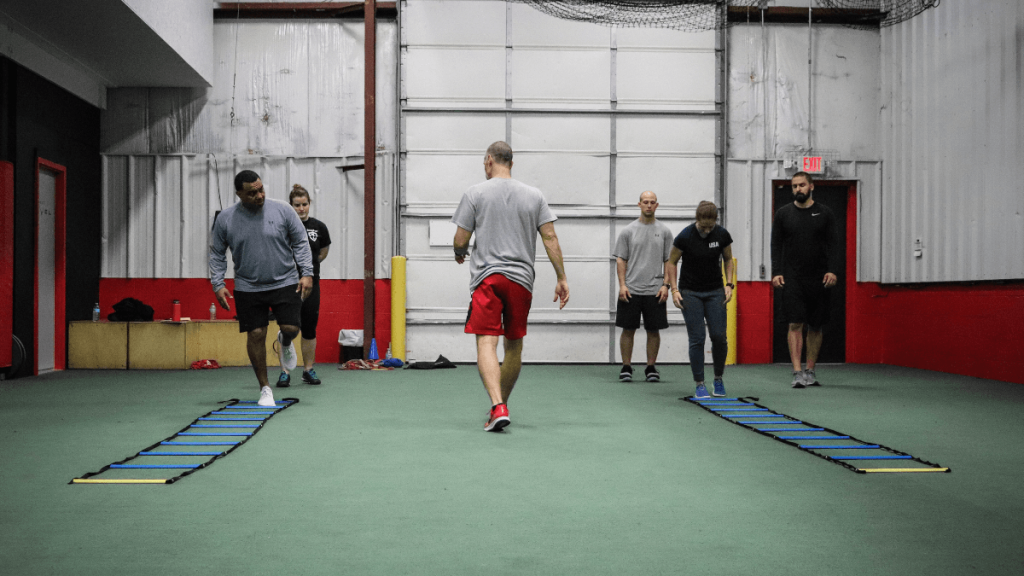
The agility ladder is often dismissed as an outdated tool, but when used correctly, it becomes an effective way to train stiffness and ground contact efficiency.
1. Single-Leg Linear Hops
Purpose: Teaches athletes to stabilize quickly upon landing while maintaining control.
2. Lateral Hops & Holds
Purpose: Develops lateral stiffness for quick changes in direction.

Low Box Training for Acceleration & Deceleration
The low box (or a weight plate) is a simple but highly effective tool for reinforcing quick stiffness responses.
1. Straddle Jumps (Non-Resisted & Resisted)
Purpose: Trains quick ground contact and rapid repositioning of feet. (Watch HERE)
2. Lateral Shuffles with Resistance
Purpose: Reinforces the ability to stop momentum efficiently in lateral movements.
Reactive Training with Resistance Bands
To simulate real-game scenarios, resistance drills introduce external forces, forcing athletes to react and adjust dynamically.
1. Straddle Jumps with Partner Resistance
- A coach or partner applies randomized resistance using a band.
- The athlete performs quick straddle jumps while maintaining balance and posture.
2. Forward & Backward Resisted Accelerations
- The athlete moves forward or backward while a band applies resistance.
- This trains both explosive acceleration and deceleration mechanics.
Key Takeaways & Implementation Through Stiffness
- Train stiffness before quickness.
- Progress from controlled to dynamic movements.
- Use resistance strategically.
- Keep drills short & explosive.
By adding these techniques to your training regimen 2-3 times per week, you’ll see noticeable improvements in speed, agility, and quickness.
Ready to take your athletic performance to the next level? Start incorporating these stiffness-based training methods today!
Ready to take your athletic performance to the next level? Start incorporating these stiffness-based training methods today with Game Like Speed!
Frequently Asked Questions About Stiffness Training for Speed and Quickness
What is stiffness in speed training?
Stiffness in speed training refers to an athlete’s ability to instantly stabilize the body when the foot contacts the ground so force can be absorbed and redirected quickly. When athletes have good stiffness, they waste less motion and can accelerate, cut, and react more efficiently.
Why is stiffness important for speed and quickness?
Stiffness is important because it helps athletes plant, stabilize, and redirect force without losing time or energy. This improves acceleration, deceleration, change of direction, and reactive movement in sport.
How do you train stiffness for faster change of direction?
Stiffness can be trained with drills that emphasize quick ground contact, controlled landings, and rapid stabilization. Examples include single-leg hops, lateral hop-and-stick drills, agility ladder work, low-box drills, and reactive movement exercises.
What happens if athletes lack stiffness?
When athletes lack stiffness, they often collapse too much at the knee or ankle during ground contact. This slows reaction time, reduces force transfer, weakens deceleration ability, and makes cuts and directional changes less efficient.
How often should stiffness training be included in a speed program?
Stiffness training can be included two to three times per week as part of a speed and movement program. Short, high-quality sets usually work best so athletes can maintain fast, controlled ground contacts without excessive fatigue.