
Training Philosophy
It is no secret that my philosophy in training revolves around natural reactive training.
It is important to give the body a chance to do what it does and then clean up the mistakes. Having this philosophy allows me to discover training techniques that enhance my belief.
Medicine Ball Training
Medicine ball training, if used properly, is just the tool to drive certain reactions in the body to help athletes move better. For example, as soon as an athlete picks up the medicine ball, the core turns on and becomes much more active. This doesn’t necessarily mean the core is functioning 100% correctly; there is no doubt it turns on and attempts to stabilize the pelvis, ribs, spine, and even shoulder girdle against the weight of the ball.
When an athlete cuts, accelerates, or decelerates aggressively, the joints and primary anchor points of the body (pelvis, ribs, spine…) need to remain stable. The core musculature, with the help of the mass and momentum of the ball, will help anchor down these critical areas of the body.
Fake Throw Training
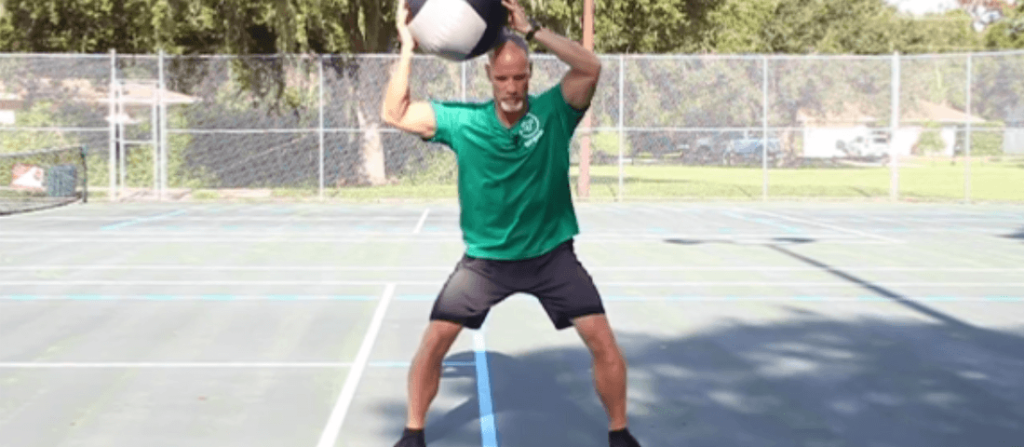
Fake Throw training simply means the athletes will never release the ball. The athlete can hold the ball still or act as if it is going to be thrown, never releasing it. Having to maintain correct postures against the mass and momentum of the ball is a fantastic training tool.
The premise behind a Fake Throw is that the athlete must use body control to maintain proper posture against the ball’s mass and momentum. Some of the positive reactions I have seen are:
- Athletes learn to stay down more in a stance that allows them to control their bodies.
- Athletes have better acceleration and deceleration angles due to the mass and momentum.
- The athlete’s body becomes more “stiff” when changing direction, and this allows for quicker movement.
- Athletes learn not to waste motions when changing direction.
- Landing technique cleans up because of the need to “stiffen” the posture against the mass and momentum of the ball.
- Single-leg deceleration improves in lunge stops, angle stops, and leaps because athletes control their core better.
There are several other positives, but the six mentioned above are the most obvious improvements I see in my athletes after several exposures to Fake Throw Training.
If you want your athletes to achieve the same results with “fake throw” training using a medicine ball, check out Medicine Ball Training for Speed.